
The Programme
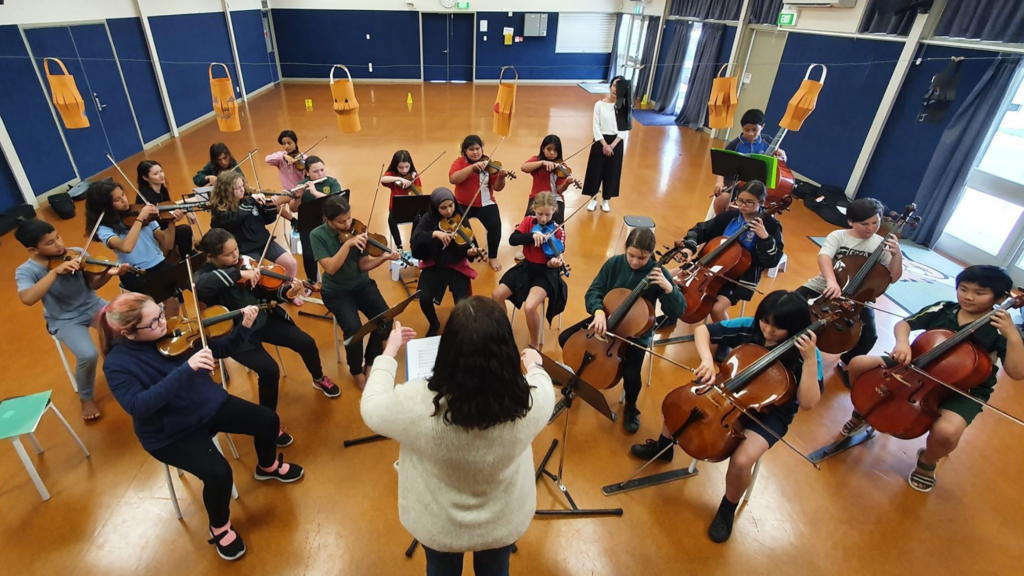
Te Rauhii operate out of Nawton School on Monday and Thursday afternoons during the school term. While this is our home base, our doors are wide open – we warmly welcome tamariki from any school across Hamilton to join our musical whaanau! We provide two streams: General Music and String Scholarships.
The curriculum of both streams utilise the Suzuki, Kodaly and Orff methodologies to foster social mobility in the community by developing social and cultural capital.
By incorporating all three methods together, tutors have witnessed students engaging with every lesson, developing a strong understanding of complex concepts with ease and sharing them with their whaanau and friends at school, prompting further engagement and participation by the passive consumers of the programme.
THE SUZUKI METHOD
The Suzuki method has been applied through the principle that all children possess ability and this ability can be developed and enhanced through a nurturing environment. A Suzuki influenced curriculum has been introduced through the instrumental curriculum, developing technique and aural ability.
THE KODÁLY METHOD
The Kodály method promotes accessible music education, introducing musical concepts through listening, singing and movement. This method promotes the development of literacy and musicianship skills, promoting musical excellence for all students.
THE ORFF APPROACH
The Orff approach includes elements of speech, dance, play, improvisation and composition, enabling the youngest children to learn in a playful and age appropriate manner.
General Music
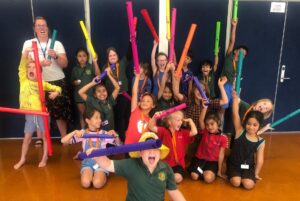
Our General Music programme is where our tamariki take their first steps into the world of music, discovering their unique creative voices in a fun, inclusive environment.
Designed for students in Years 1 to 8, we dive straight into the hands-on joy of making music. Our tamariki get to explore a wide variety of instruments and musical styles, rotating through and discovering:
Percussion: Channeling high-energy rhythm through bucket drumming, xylophones, and boomwhackers to build coordination, pulse, and collective timing.
Melodies: Learning the foundations of violin, ukulele, and recorder, which helps develop fine motor skills, pitch, and musical confidence.
Expression: Bringing music to life through collective choral singing and folk dance, internalising musical concepts naturally through movement and play.
At Te Rauhii, we don’t just teach children how to play notes; we teach them how to listen to one another. Group music-making is a powerful tool for social development. When tamariki play in an ensemble, they learn the vital skills of cooperation, active listening, and mutual respect.
Within an ensemble, every single child’s contribution is vital. By collaborating, they discover the true joy of shared achievement, weaving their individual efforts into a beautiful, collective masterpiece.
String Scholarships
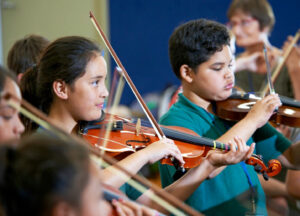
The String Scholarship programme is designed for tamariki and rangatahi who have discovered a deep passion for music and are ready to take their creative journeys to the next level.
Our scholarships offer intensive, fully-funded tuition in violin or cello. By removing all financial barriers we ensure that advanced classical music education is accessible to any dedicated young person in our community, regardless of their background.
The scholarship includes:
One-on-one mentorship: Individual lessons with our highly skilled tutors, tailored to each student’s unique pace and potential.
Group music theory: Group musical theory lessons, building essential literacy in reading, writing, and understanding musical notation alongside their peers.
String ensembles: Collaborating in small string ensembles to practice collective harmony and performance.
Exam opportunities: The opportunity to sit internationally recognised practical and theory examinations, celebrating their achievements and build pathways for future tertiary study.
Community Performance Pathways: Opportunities to perform alongside experienced musicians, including collaboration with groups such as Youth Orchestra Waikato (YOW) and Waikato Community School of Music (WCSM).